Short-let management tips: what is the best check-in method to manage your short-let?
Summary: Picking the right check-in method is the first step to create a smooth and effective short-let management system. Self-check-ins can be suitable for properties where guests are expected to arrive late or leave early, such as close to airports and important transport links or in inner city areas. While personal key handovers create a homely feel which is more suitable for more relaxed holiday destinations.
When Airbnb started, it was to share an empty room in your house, meet new people passing through your city, and generate some extra income. But short lets nowadays evolved into an almost hotel-like business, where guests often expect refreshments, 0-24 help lines, and personal touches. In this short article, we will look at the pros and cons of key boxes and self-check-ins, as well as personal key handovers in today’s short-let management landscape.
Why does check-in matter?
With short lets evolving and owners usually not living within the same property as the one they rent out, the question of check-in arises. A smooth check-in is the first step towards a relaxing holiday and a happy, positive review. This is the point where you can show yourself to your guests, ensure they feel seen, they know all they need to know to have the perfect time, and sort out any potential issues. This means that creating the perfect check-in process is an essential step for all hosts.
Personal key handover

Personal key handover is a great way to create a personal feel for your guests during their stay. You can meet the guests in person, show them around the property, show how everything works, and give them tips on the best restaurants or the closest shop. This will make you seem approachable, so they will feel more confident to get in touch with you in case any issues arise,
making it easier to smooth away any problems before they create a negative review. You can also have a look at your guests and ensure they are suitable for your apartment.
However, personal key handover is time-consuming and can be inconvenient to both you and your guests. If guests are arriving very late or very early, they may feel embarrassed to wake you up at 4 am to pick up the keys when they arrive from the airport. They may feel stressed on their way, and they feel there is a deadline – they promised themselves at 5 pm, so they cannot
be late! A lock box (a common method for self-check-in) can also be convenient if they don’t want to carry the keys with them everywhere, as they are worried about losing them.
Lock boxes and codes
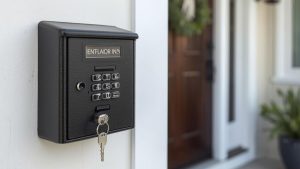
On the other hand, self-check-ins through lock boxes and codes are convenient for both parties. It is easier for time management as you will never need to worry about scheduling key handovers if you have multiple short let properties.
However, with self-check-in, it is easy to become complacent and rely on technology too much. Key boxes can get damaged, and code locks can malfunction. You will also need to think about regularly changing your codes, unless you want to risk previous guests coming back without warning. In addition, without a personal meeting, you need to think of different ways to give your property a personal touch and build up a relationship with your guests. Therefore, communication before and after arrival is key.
Conclusion
Which method is the most suitable for you will depend on the number of properties you manage, their locations, your availability, and the type of guests who usually visit your properties.
For example, if you have a property close to Manchester Airport and one closer to the Peak District, two streets down from your residence, you may prefer a self-check-in to your airport property, as it will be popular with guests catching early flights or arriving late. However, as your other property is nearby to you and in a more relaxing location, guests taking out that property may enjoy more of the personal touches provided by personal key handovers, where they can ask you about local walks or the best pubs. While you can also put out temporary lock boxes when going away on a holiday, or if a guest is expected to arrive at a less sociable hour.
Either way, it is an important decision that can make or break your guests’ experience, so it requires proper planning. Getting in touch with experienced hosts in your area can help you get personalised advice on which is the best option for you.